
Honey and cheese: the pairings behind a festive cheeseboard
Roquefort, Stilton, Comté, fresh goat’s cheese, Brie: which honey to serve with each cheese, in what order to build the board, and which almonds to slip in between.
In the second century BC, Cato the Elder was already writing down the recipe for a Roman cake: fourteen pounds of fresh sheep’s cheese, four and a half pounds of honey, built up in layers in a pastry. Cheese and honey are no trend: they are one of the oldest pairings at the table. So, every December, the question: which honey with which cheese? Here are the House’s pairings, and how to build a festive cheeseboard that reads like a story.
Contents
The festive cheeseboard, pairing by pairing

The rule of contrast: sweet against salty, rich against floral
Honey and cheese suit each other because they oppose each other. The salt of the cheese brings out the sweetness, and the honey rounds off whatever is sharpest. A fine pairing does not stack two flavours: it lets them talk.
Taste science has measured it. In 1997 Paul Breslin and Gary Beauchamp showed in Nature that salt suppresses bitterness far more than sweetness, so the sweet note stands out. On a salty cheese, bitterness recedes and the sweetness of the honey lengthens.
Our rule follows: one honey per family of cheese, chosen for what the cheese lacks. Our guide How to taste honey: 12 moments gives one of its moments to cheese; this is the long version, made for the festive season. The rule has one exception, kept for the end of the next chapter.
Which honey with which cheese
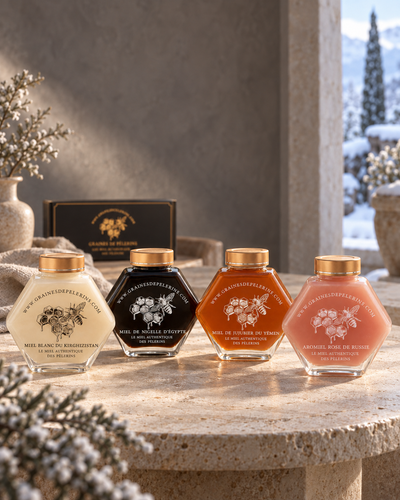
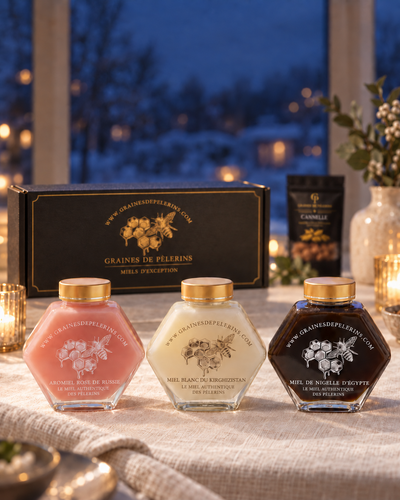
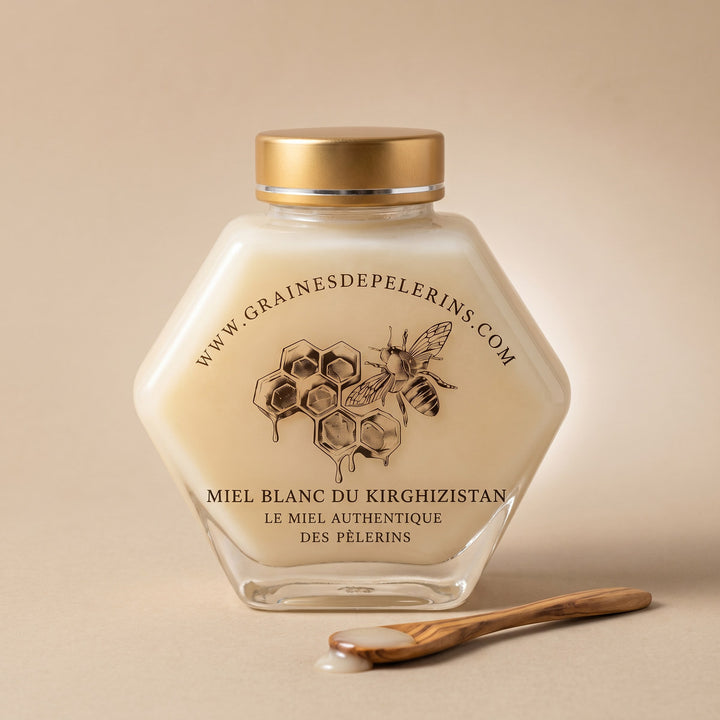
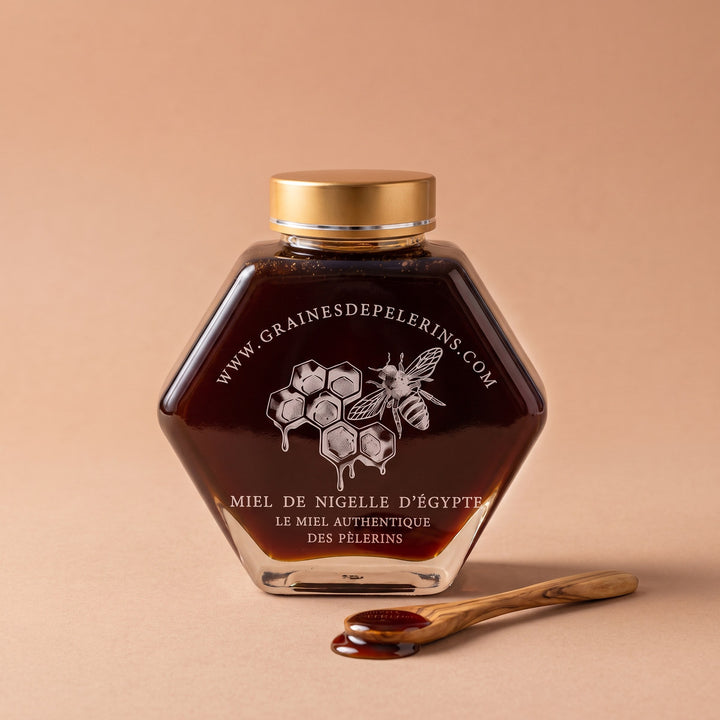
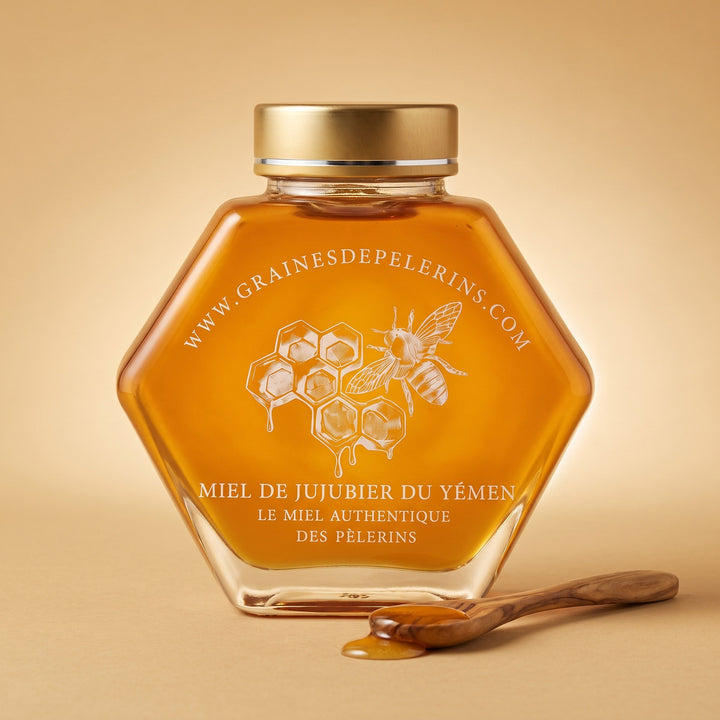
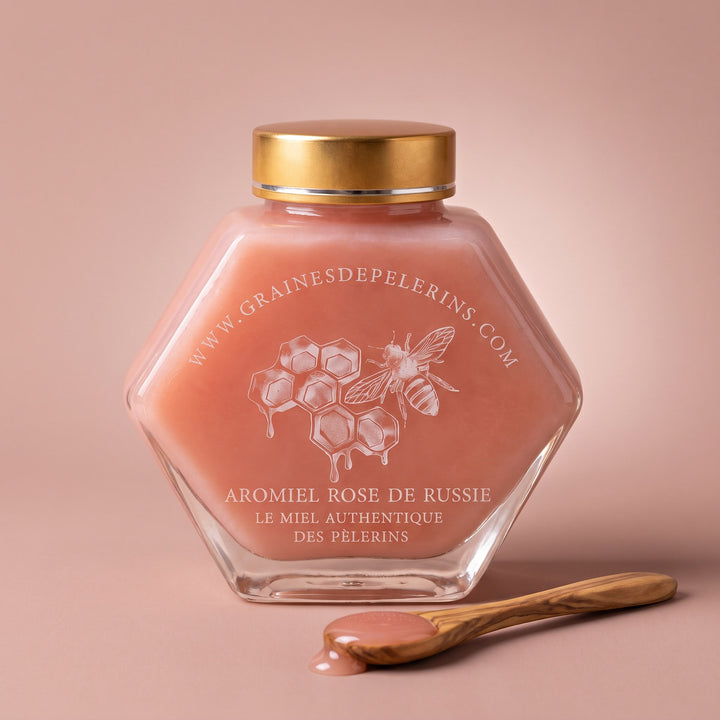
For a festive board, the House pairs Roquefort and blue cheeses with Jujubier Honey from Yemen, Comté and hard cheeses with Egyptian Black Seed Honey, fresh goat’s cheese with the Rose Aromiel from Russia, and Brie and creamy cheeses with White Honey from Kyrgyzstan.
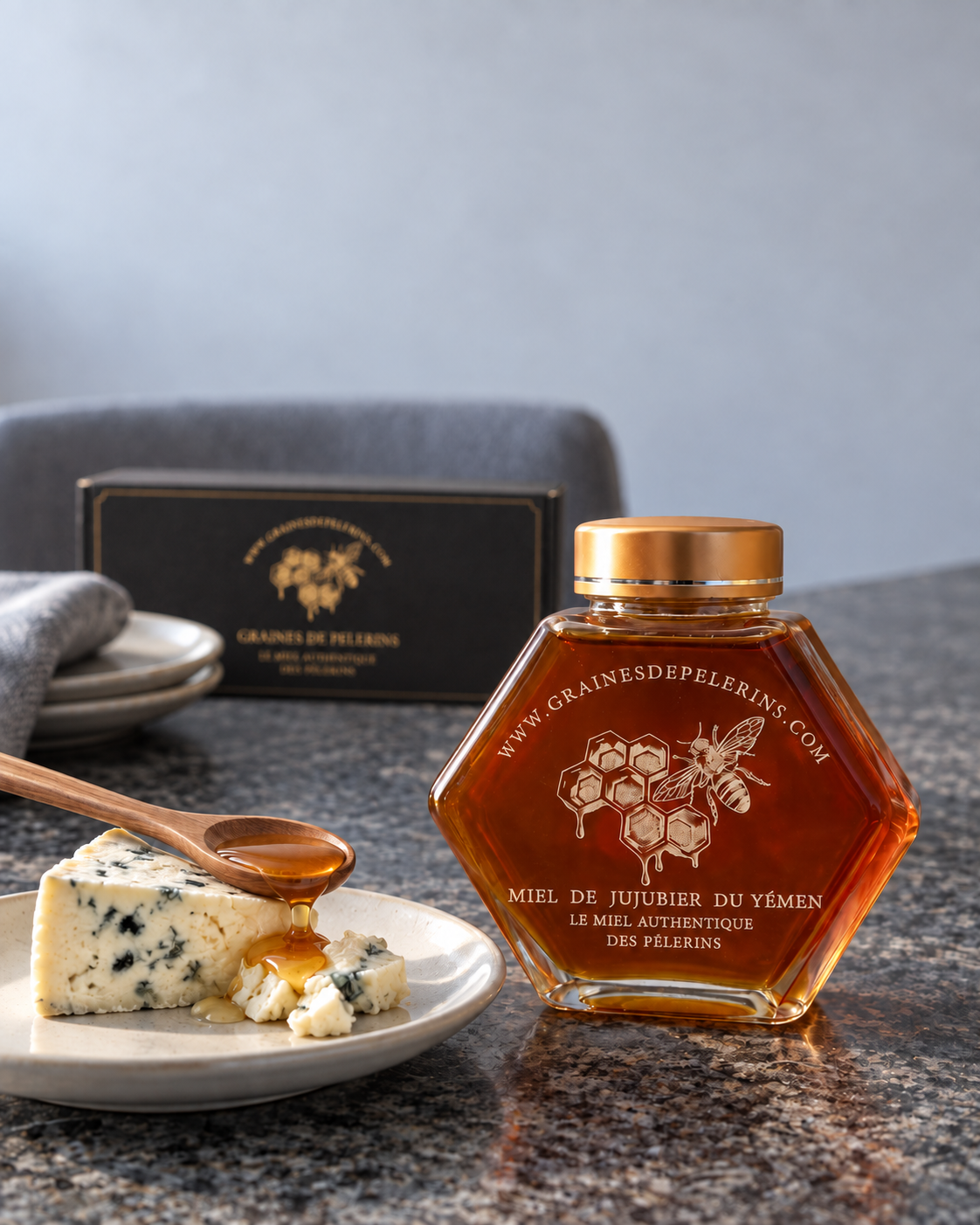
Roquefort, Stilton and other blues: Jujubier Honey from Yemen
Roquefort has a royal history. In 1411 a charter of King Charles VI already protects it, “in a country where neither vine nor wheat grows”. A law of 26 July 1925 then gave it the first regulated appellation of origin for a commercial cheese.
Even its blue comes from the place: Penicillium roqueforti is prepared from strains isolated in the Combalou caves where it matures.
Britain has a blue with a surprise of its own: Stilton cannot be made in Stilton. Only cheese made in Derbyshire, Leicestershire and Nottinghamshire may carry the name, and the village lies in Cambridgeshire.

Against that salt, you need a honey that does not step back. The Jujubier opens on caramel, moves to warm wood and holds a very long finish. One drop on a Roquefort or a Stilton: the blue opens first, then the honey carries on. But a board that starts with its strongest has nothing left to tell. It needs a more patient cheese.
Comté, Cheddar and hard cheeses: Egyptian Black Seed Honey
A wheel of Comté takes more than 400 litres of milk, the milk of twenty Montbéliarde cows, then at least four months in the cellar. There is no industrial Comté: it is born in village dairies, the “fruitières”. Depending on maturation, its aromas run from hazelnut to pepper, by way of coffee.
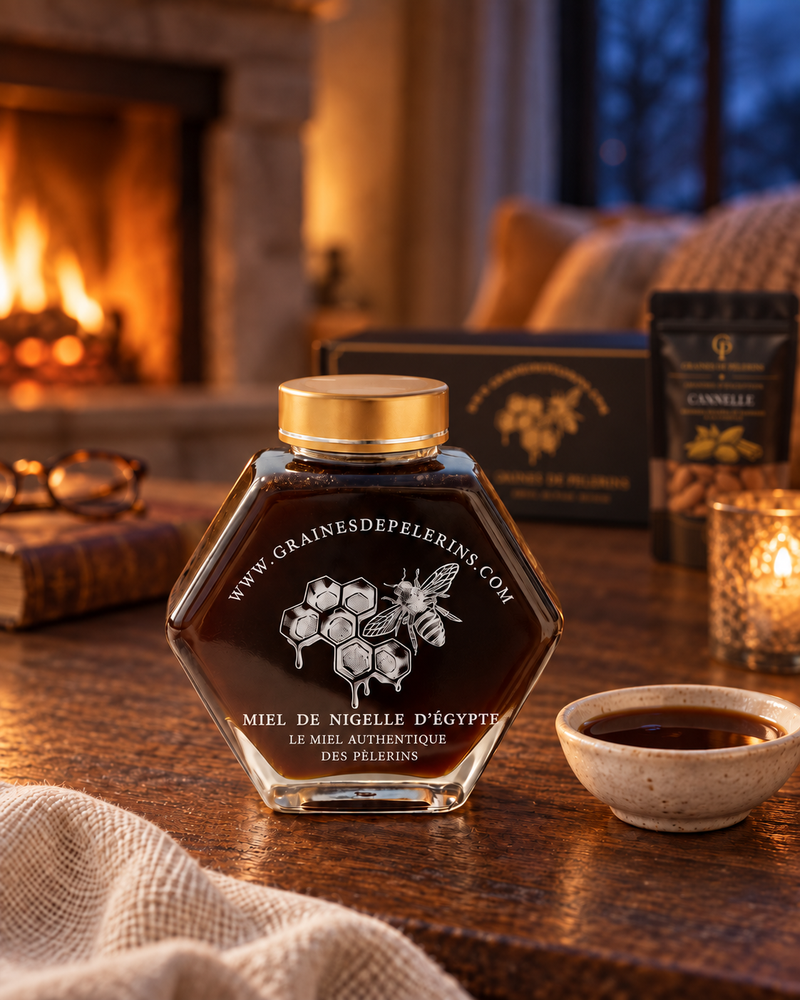
It is that pepper which calls for the Black Seed Honey. Mahogany and dense, it opens on a deep sweetness and ends on a peppery note that comes from the flower: no seed is added to the jar. On a mature Comté, a farmhouse Cheddar or a sheep’s cheese, the two finishes answer each other. The plant, nicknamed “black cumin”, is in fact a cousin of the buttercup.
Fresh goat’s cheese: Rose Aromiel from Russia
Fresh goat’s cheese, lively and tangy, asks for fruit. The Rose Aromiel from Russia is not a rose honey: it is a preparation of acacia honey worked cold with rosehip, the fruit of the dog rose. Its colour comes from that fruit, not from a flower.
The acacia opens first, then the tender fruitiness of rosehip: on fresh goat’s cheese, acidity and fruit cross without covering each other. Never above 40 °C: its fragrance is volatile.
Brie and burrata: White Honey from Kyrgyzstan
Here is the promised exception: against a bloomy rind, we play echo rather than contrast. White Honey is a sainfoin honey harvested at altitude in the Tian Shan. A botanical surprise: sainfoin flowers are pink, yet its honey, crystallising naturally, becomes an ivory cream. Nothing is added, nothing whipped.
On a Brie or a burrata, its almost milky note extends the cream of the cheese. All that remains is to bring it all together on one board without getting lost.
The pairings table
One line per cheese, the honey that answers it and the gesture that makes the pairing work.
| Cheese | Honey | The gesture |
|---|---|---|
| Roquefort | Jujubier Honey | A single drop, on the veined heart |
| Stilton | Jujubier Honey | A fine thread, on a thick slice |
| Mature Comté | Black Seed Honey | A dab, on a chip of the paste |
| Fresh goat’s cheese | Rose Aromiel | At the last moment, never heated |
| Brie | White Honey | A nugget of cream on the paste |
| Burrata | White Honey | In the centre, just before serving |
A drop of honey, never a pool: the cheese speaks first, the honey has the last word.
The House’s tasting ruleThe table says what to serve, not in what order.
Building the board in five steps
Take the cheeses out an hour and a half ahead, arrange them from mildest to strongest, and serve each honey in its own small dish, with its spoon.
Step one, time. The French dairy trade body advises letting cheeses come to life for at least 1 h 30 at room temperature. The honeys never go in the fridge.
Step two, the board. Wood, slate or marble. Avoid metal, which can taint cheese.
Step three, the order. From mildest to strongest, clockwise: burrata or Brie, fresh goat’s cheese, sheep’s cheese, Comté, then the blues. The honeys follow the same slope: White Honey, Rose Aromiel, Black Seed, Jujubier.
Step four, one spoon per honey. One knife per family of cheese, one spoon per jar: flavours stay clean.
Step five, measure. People often count 60 to 80 g of cheese per guest after a meal. For the honey, half a teaspoon per pairing: it underlines, it does not coat. One thing is missing, though, that your guests will look for without knowing its name: the crunch.
Adding the crunch: Edam, Salt & Smoke and Chilli almonds
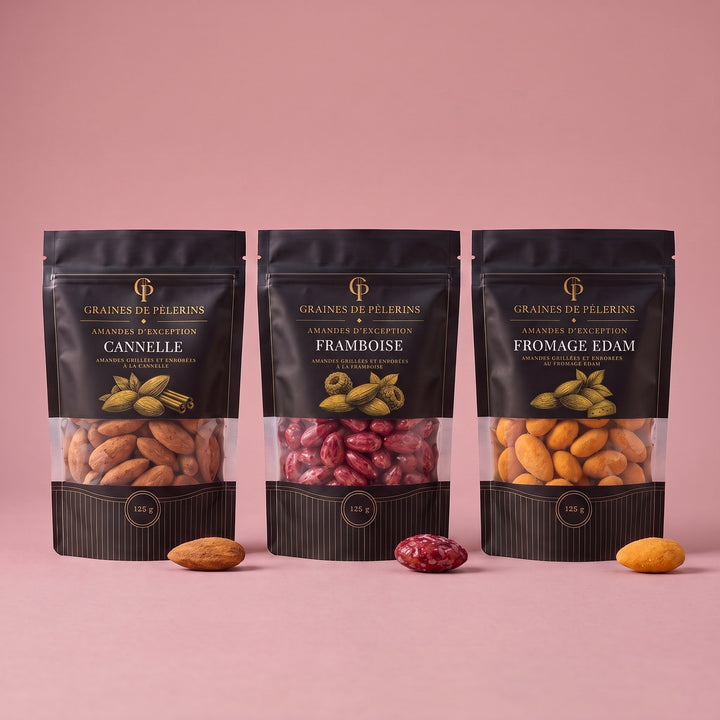
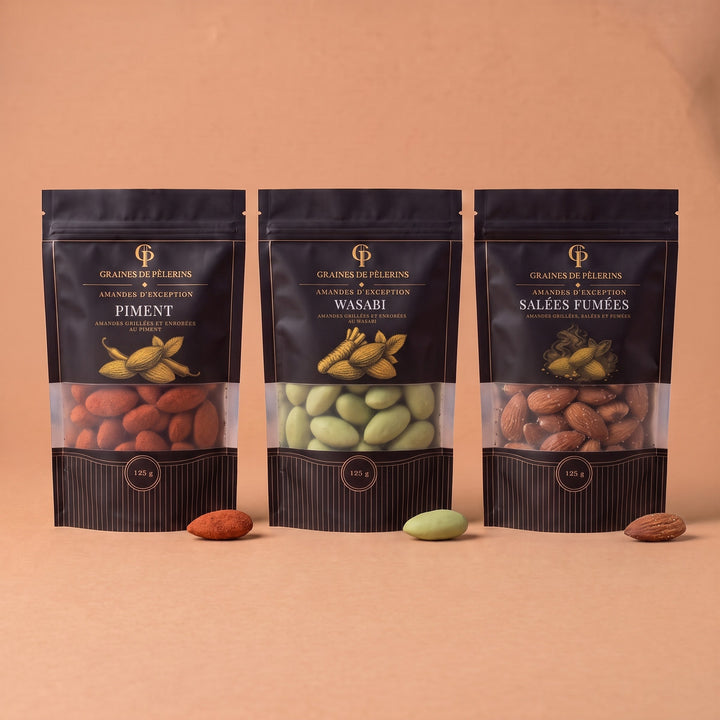
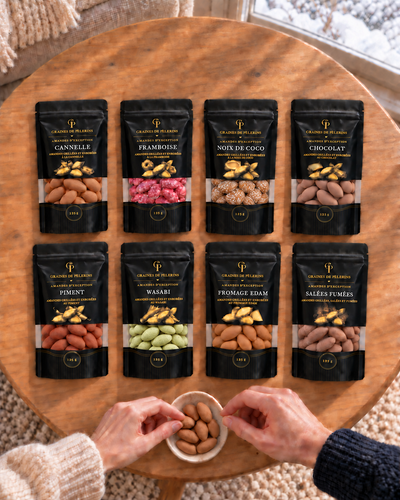
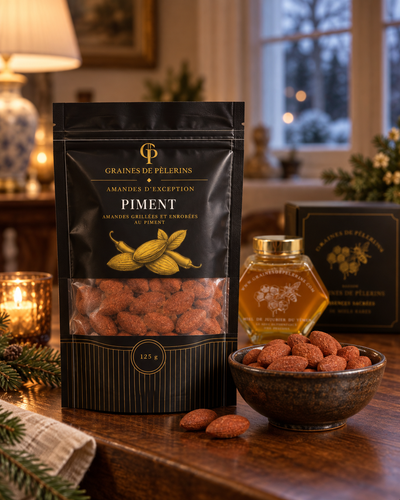
Between two cheeses, a coated almond refreshes the palate: Edam for salt, Salt & Smoke for fire, Chilli for heat.
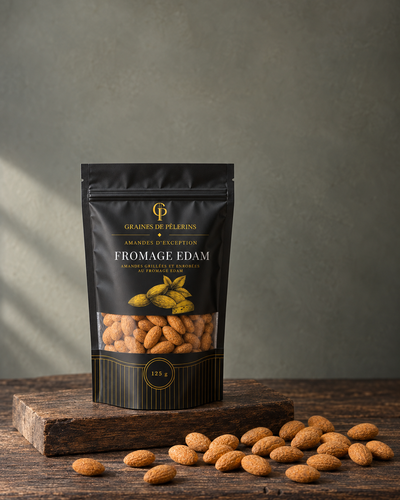
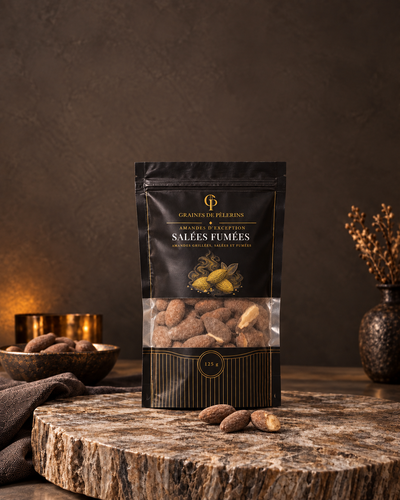
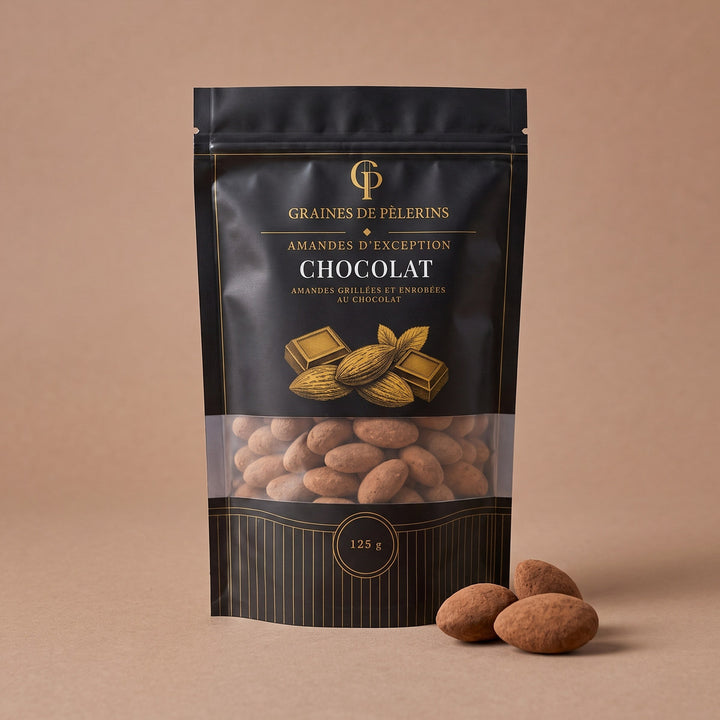
The House has already married its honeys with its almonds: Black Seed with the Edam Cheese Coated Almonds, Jujubier with the Salt & Smoke Coated Almonds. On a board the frank salt of the Edam joins the Black Seed Honey beside the Comté, and the smoke extends the fire of the Jujubier next to the blues.

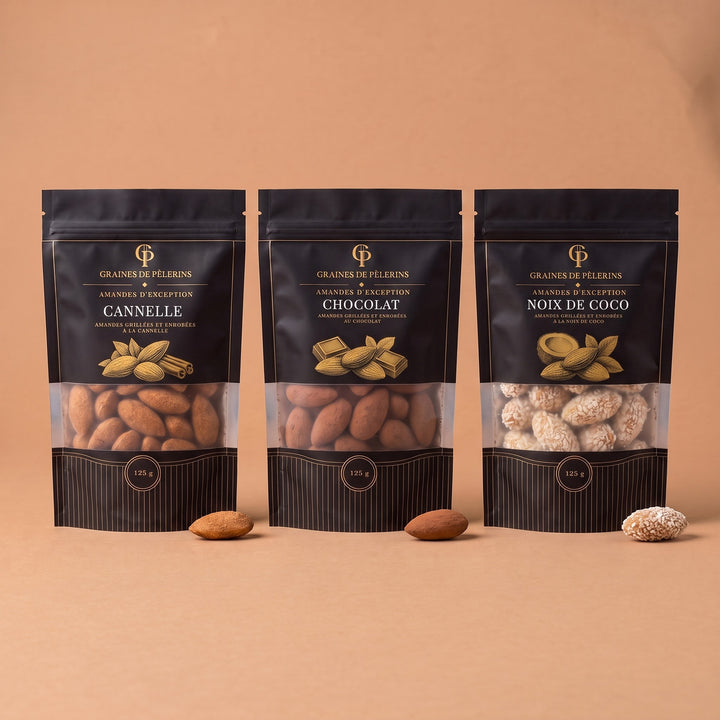
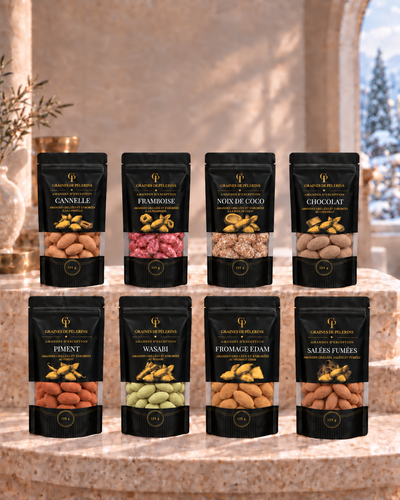
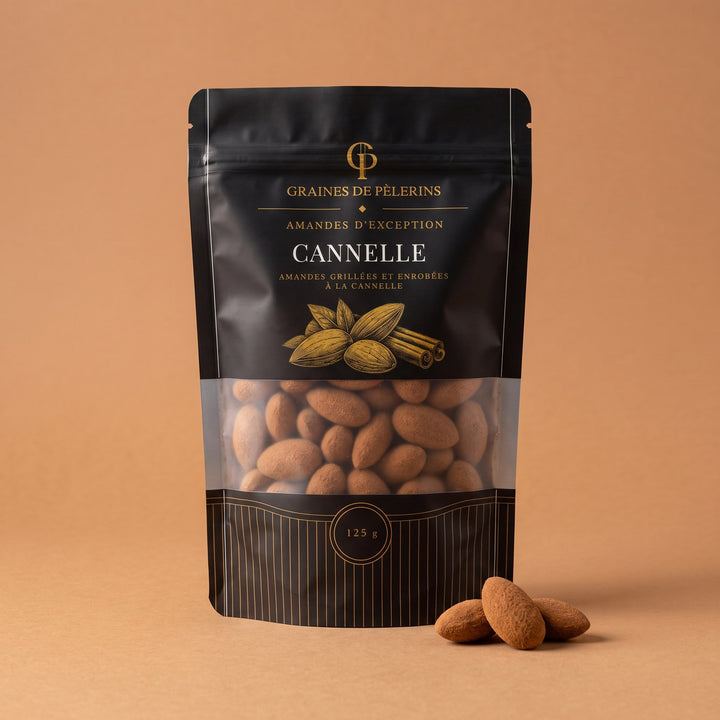
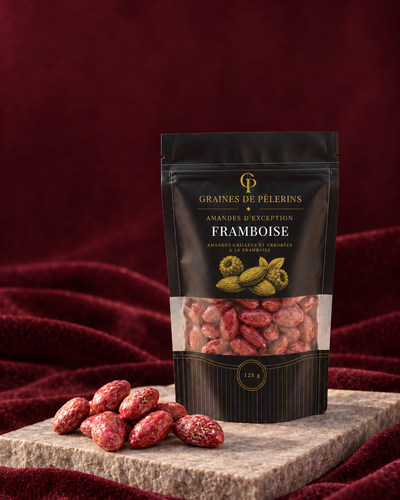
For palates that like the heat to rise, the Chilli Coated Almonds bring a robust, progressive note, without brutality. Each flavour comes in a 125 g bag at €19.90, or in a set of three, 375 g, at €36.90.
Almonds are tree nuts, and the Edam coating contains milk. All our pairings are gathered on the page Honey and almond pairings. A board like this can also be given, provided you choose the right box.
Giving the board: one box, three honeys
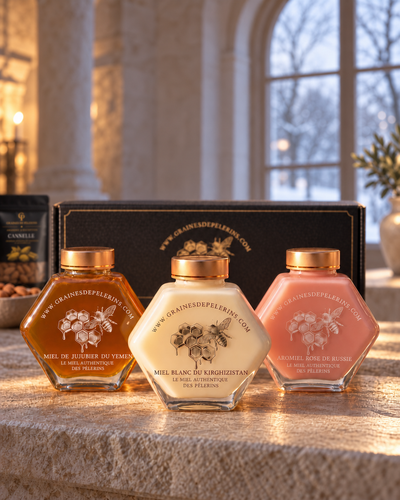
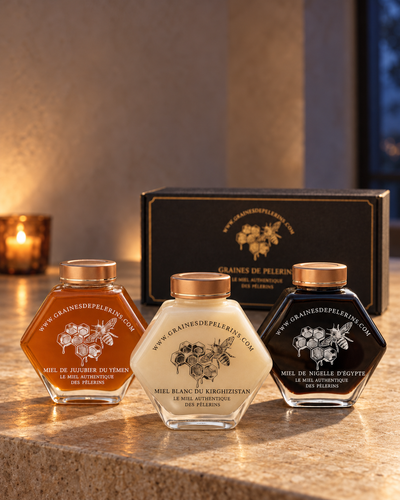
One box brings together the three honeys of the blue, the hard cheese and the cream: the Jujubier, the Black Seed and the White Honey. Three jars, three spoons.

Gift box · Blue, hard cheese, cream
The Ritual Box €79.90
Discover the gift boxIf fresh goat’s cheese takes pride of place, The Prestige Box swaps the Black Seed for the Rose Aromiel, in the black and gold box. Both boxes are €79.90; bought separately, their three jars cost €101.70. Free Mondial Relay delivery · France, Belgium and Luxembourg. Orders are usually prepared within 48 working hours, then delivered within 3 to 5 working days in France and Belgium.
Frequently asked questions
Which honey goes with Roquefort or Stilton?
A generous honey that stands up to the salt. The House serves the Jujubier Honey from Yemen: one drop on the veined heart of a Roquefort, or a fine thread on a slice of Stilton, and its caramel and warm wood extend the finish of the blue.
How much honey should I allow per person for a cheeseboard?
Half a teaspoon per pairing is enough: the honey underlines the cheese, it does not cover it. For the cheese itself, people often count 60 to 80 g per guest after a meal.
Should I warm the honey before serving it with cheese?
No. Serve it at room temperature, like the cheeses. The Rose Aromiel from Russia must never go above 40 °C, because its fragrance is volatile. White Honey is naturally creamy: that is its texture, not a flaw to correct.
What should I drink with a honey and cheese board?
The pairing is enough on its own. If you serve wine, choose it for the cheeses and keep the honey as a light touch. For an alcohol-free table, a briefly brewed black tea or sparkling water leaves the board centre stage.
Sources
- Cato the Elder, On Agriculture, chapter 76, the placenta recipe (Hooper and Ash, Loeb, 1934), on LacusCurtius
- Wikipedia: De agri cultura (in French): written c. 160 BC.
- French Ministry of the Economy: the 1411 charter and the law of 1925 (in French).
- INAO: specification of the Roquefort appellation (in French).
- Breslin P. A. S. and Beauchamp G. K., “Salt enhances flavour by suppressing bitterness”, Nature, vol. 387, 1997
- Wikipedia: Stilton cheese: designation of origin, the three counties.
- French Ministry of Agriculture: Comté AOP, 17 December 2025 (in French).
- Kew, Plants of the World Online: Nigella sativa, family Ranunculaceae
- Sorbonne Université, herbarium: sainfoin, pink flowers (in French).
- Produits laitiers (CNIEL): how to compose a cheeseboard (in French).
- Président: how much cheese per guest (in French).
- The House’s product pages (read on 1 October 2026) and the page Honey and almond pairings.
To give the board
Which box for which table?
Three boxes, three combinations of honeys. Our guide compares them, jar by jar.
Compare the boxes →In the same spirit: “Rose honey” explained · Storing honey
Editorial information. The content of this article is strictly informative, cultural and sensory. It describes the geographical origin, the botanical composition, the aroma profile and the traditional uses of rare honeys. It is not medical advice, a diagnosis, or a recommendation for treatment. Honey is a foodstuff. For any medical question, consult a qualified professional. Compliant with Regulation (EC) No 1924/2006.
Continue exploring
Pairings
The 13 desserts of Christmas in Provence: who counted to thirteen?
Mistral counted only eleven. Where does thirteen come from, what really sits on the table at Christmas in Provence, and how to set your o...
Read the article
Guide
Pain d’épices: the story of French honey spice bread, and a real recipe
For centuries, pain d’épices was a loaf of honey and rye whose dough waited for weeks. From Reims to Nuremberg, its history, the part hon...
Read the article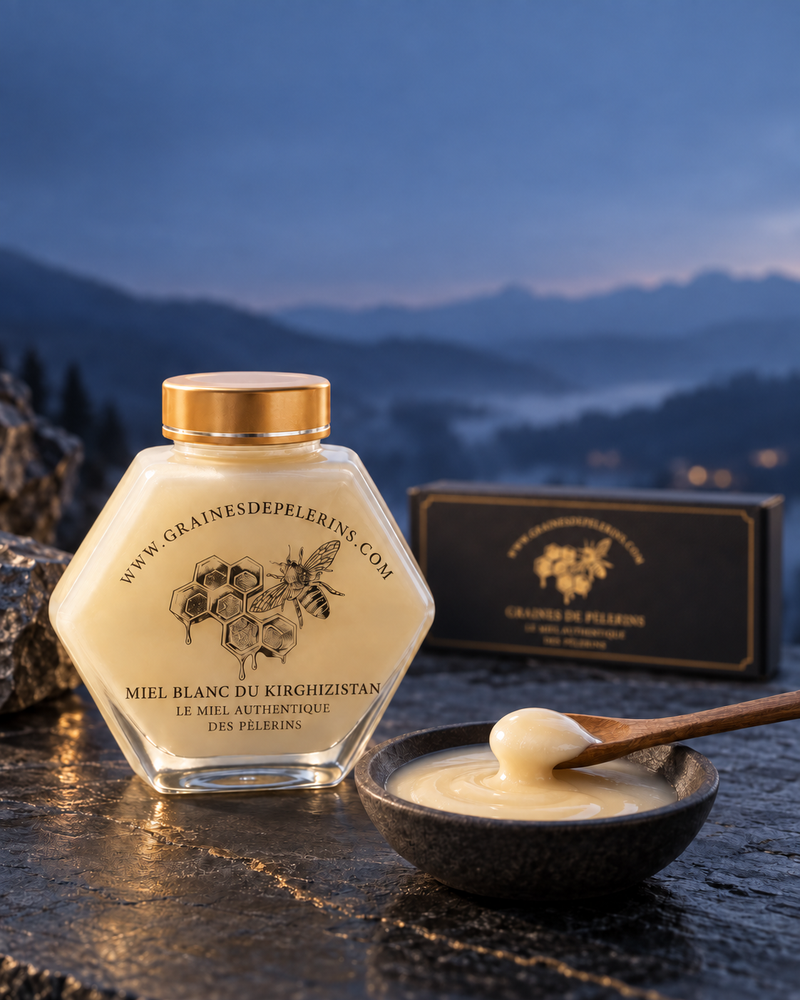
Classements
The best honey in the world: what the rankings say, what really counts
In 2025, the world beekeeping congress gave up awarding a honey. What contests and rankings are really worth, and the five criteria that ...
Read the articleDiscover our rare honeys
Four exceptional origins, limited harvests, gift boxes made for giving and for tasting.
See the collectionAlso worth discovering: our Almonds of Distinction