


Habba sawda and black seed honey: a morning tradition
Black seed, habba sawda, has been part of Egyptian kitchens for millennia. Here is the difference between the seed and the honey, and how the morning gesture fits into an ordinary day.
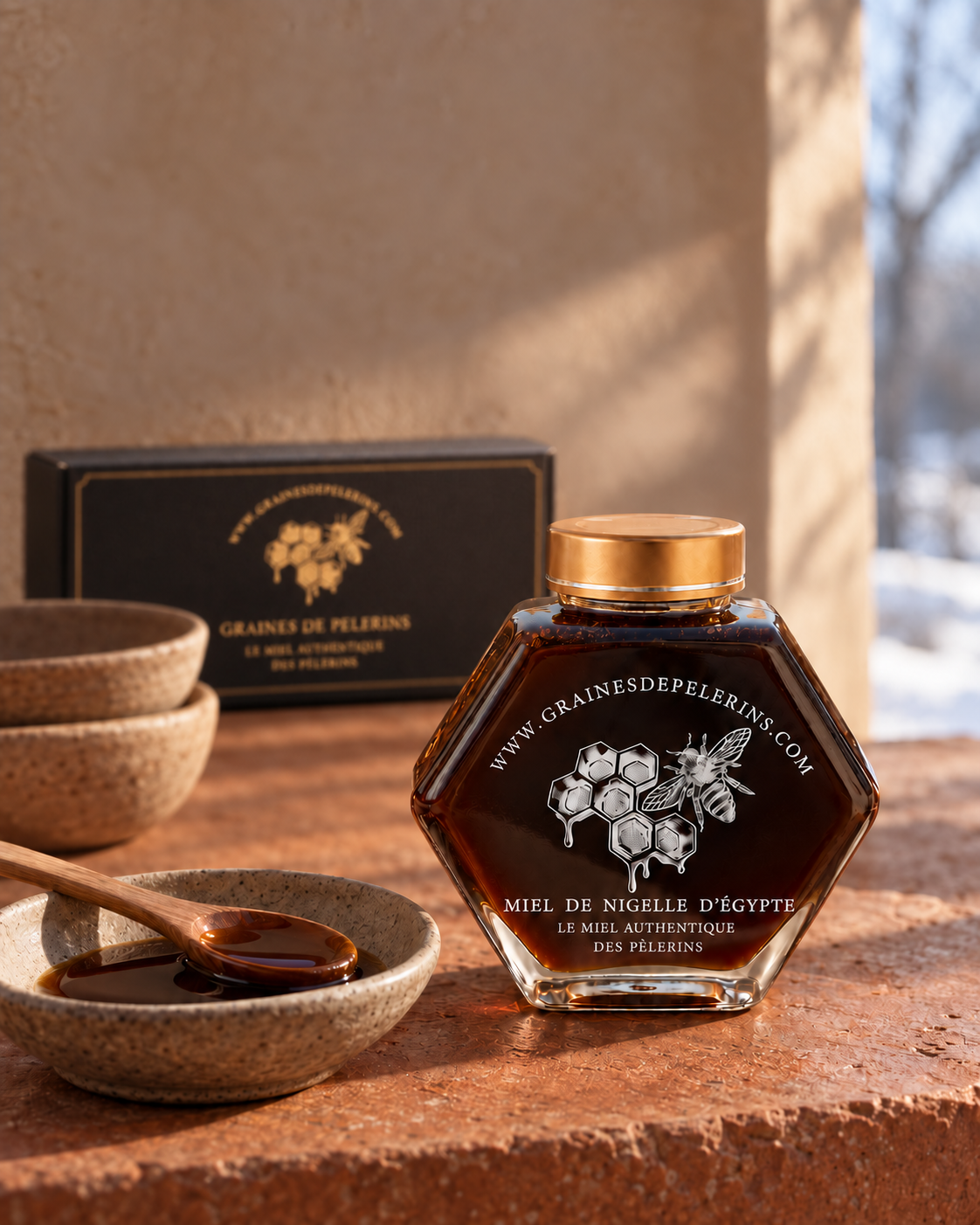
In the morning, before your coffee, to taste the honey on its own: a teaspoon of black seed honey (Nigella) set on the tongue. The gesture is one of the oldest in the Mediterranean, practised in the Nile Delta for three thousand years and handed down under the name habba sawda, the black seed. What you are giving your palate is not a habit: it is a thread stretched between ancient Egypt and a modern kitchen.
Contents
Habba sawda, the tradition

The origin: the Nile Delta
Black seed honey comes from the fertile plains of the Nile Delta, in northern Egypt. Black seed (Nigella sativa) has been grown there since ancient Egypt, and its flowering runs over four to six weeks between February and March. Traditional beekeepers set their hives beside the cultivated fields for that period. The practice is old and barely changed: clay hives, linen veils, a craft passed from father to son in step with the seasons.
The Pilgrim's Recipe
The ritual comes down to three simple gestures, two minutes in the morning.
First, before your coffee. Set five grams, one teaspoon, of black seed honey on the tongue, to taste the honey on its own. No tea, no coffee first: the palate takes in the whole aroma profile.
Then let it melt. One to two minutes. That is the time it takes to make out the layers of the honey: the spiced attack, the caramelised body, the woody finish. It is also the time it takes to be present to what you are doing, the forgotten half of modern tasting.
Finally, the coffee or tea. The first drink of the morning meets a palate that still holds the woody finish of the black seed honey.
Three thousand years. One flower. One morning gesture. Black seed honey is not telling us about a trend: it is telling us about a memory.
The Graines de Pèlerins doctrineSensory profile
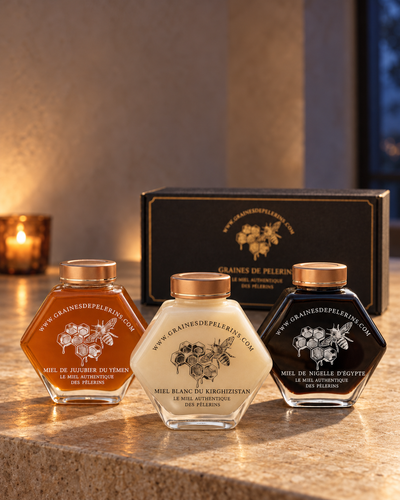
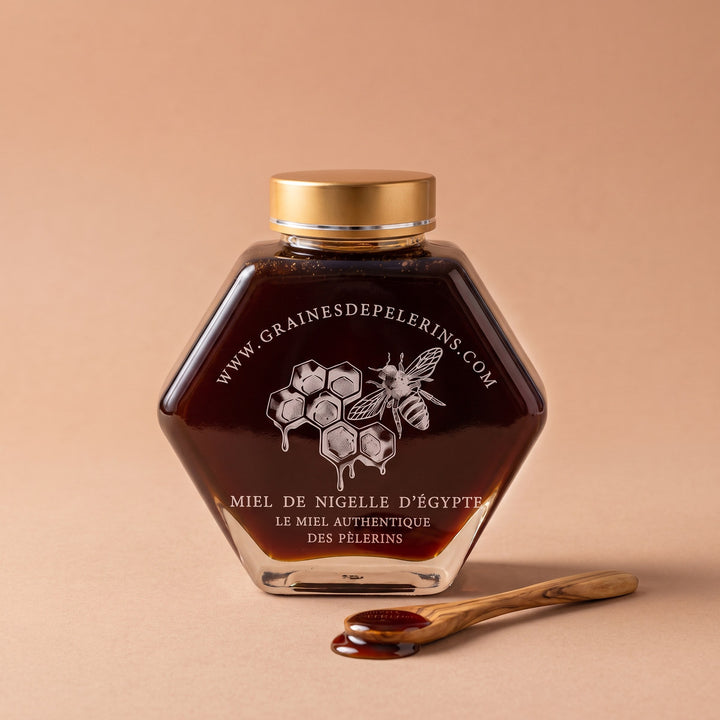
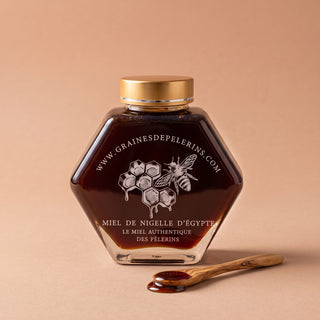
To the eye, black seed honey runs from golden amber to mahogany brown. The texture is fluid to unctuous depending on the temperature. In the mouth the attack is spiced, with notes of toasted and caramelised dried fruit, and the finish is woody, long and persistent. It is one of the most distinctive honeys there is, and one of the hardest to forget once tasted.
Habba sawda: seed, oil or honey
Three distinct products often carry very similar names. Habba sawda is the seed itself, from the plant Nigella sativa. Black seed oil, habba sawda oil, is pressed from those seeds. Black seed honey is made by the bees from the flowers of the plant: it is nectar transformed, not an extraction. Three different uses, one way of naming the plant they come from.
Recognising a genuine black seed honey
Four signs: an origin documented to Egypt and the Nile Delta, a colour from golden amber to brown, the distinctive spiced and caramelised aroma profile, and pollen analyses confirming the single-flower character. To go further: our guide to authenticating black seed honey.
Egypt · Nile Delta
Egyptian Black Seed Honey From 19,90 € / jar
Take up the ritualGoing further
- How to recognise a genuine black seed honey
- Our three rare honeys compared
- The five great regions of rare honey
- The seven rarest honeys in the world
Sources & References
- Manniche L. An Ancient Egyptian Herbal. British Museum Publications, 1989.
- Egyptian Beekeeping Federation. Traditional Honey Production in the Nile Delta.
Editorial information. The content of this article is strictly informative, cultural and sensory. It describes the geographical origin, the botanical composition, the aroma profile and the traditional uses of rare honeys. It is not medical advice, a diagnosis, or a recommendation for treatment. Honey is a foodstuff. For any medical question, consult a qualified professional. Compliant with Regulation (EC) No 1924/2006.
Continue exploring
Pairings
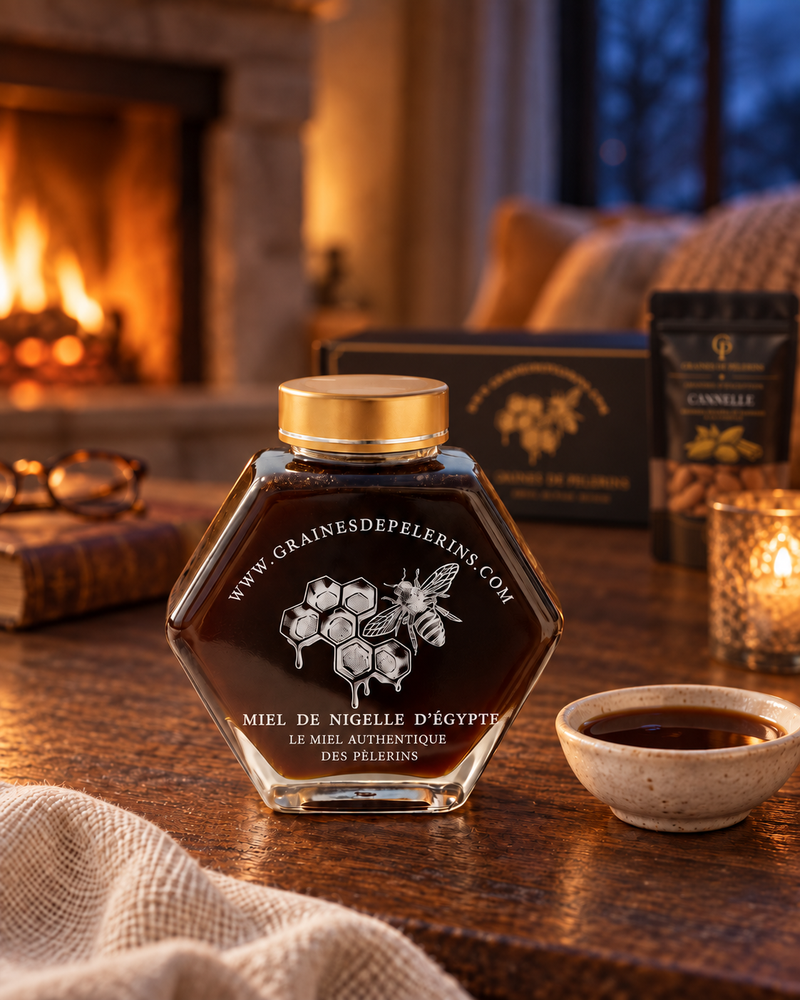
The 13 desserts of Christmas in Provence: who counted to thirteen?
Mistral counted only eleven. Where does thirteen come from, what really sits on the table at Christmas in Provence, and how to set your o...
Read the article
Guide
Pain d’épices: the story of French honey spice bread, and a real recipe
For centuries, pain d’épices was a loaf of honey and rye whose dough waited for weeks. From Reims to Nuremberg, its history, the part hon...
Read the article
Classements
The best honey in the world: what the rankings say, what really counts
In 2025, the world beekeeping congress gave up awarding a honey. What contests and rankings are really worth, and the five criteria that ...
Read the articleDiscover our rare honeys
Four exceptional origins, limited harvests, gift boxes made for giving and for tasting.
See the collectionAlso worth discovering: our Almonds of Distinction