
Black Seed Honey: telling taste from proof
Colour, texture and taste help describe Black Seed Honey. To assess its origin and authenticity, you need relevant information and analyses.
Colour, flow and taste help you discover a black seed honey, but they are not enough to prove it is genuine. To choose, tell apart the product as described, its composition, its declared origin and the documents that go with it. The five pointers below are not home authentication tests.
Contents
Recognising a genuine black seed honey

Check the label
Look at the product name, the declared origin and the batch information. For our honey, the stated origin is Egypt, in the Nile Delta. A floral name has to be told apart from a honey to which seeds or oil have been added: check the composition of the product in question.
Look at the colour
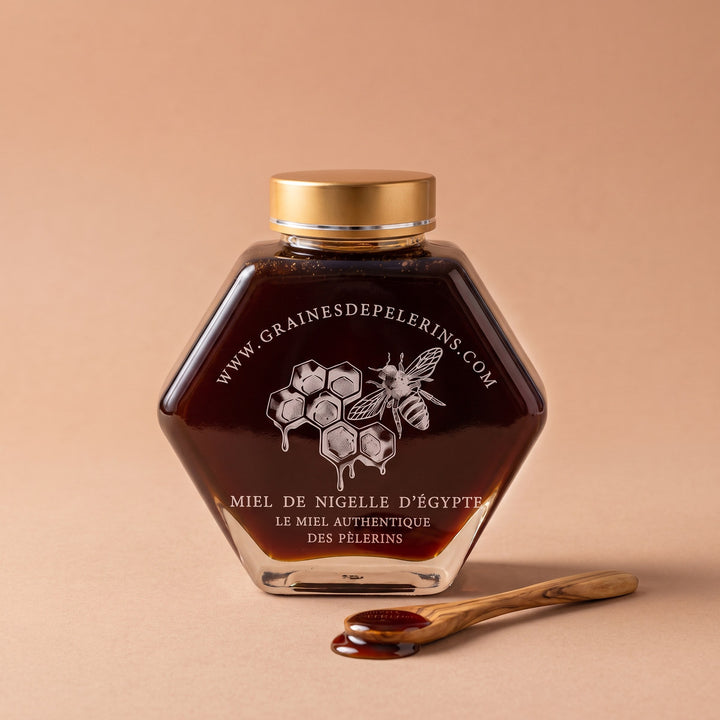
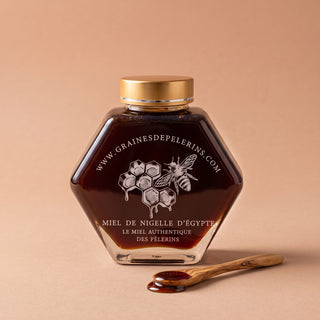
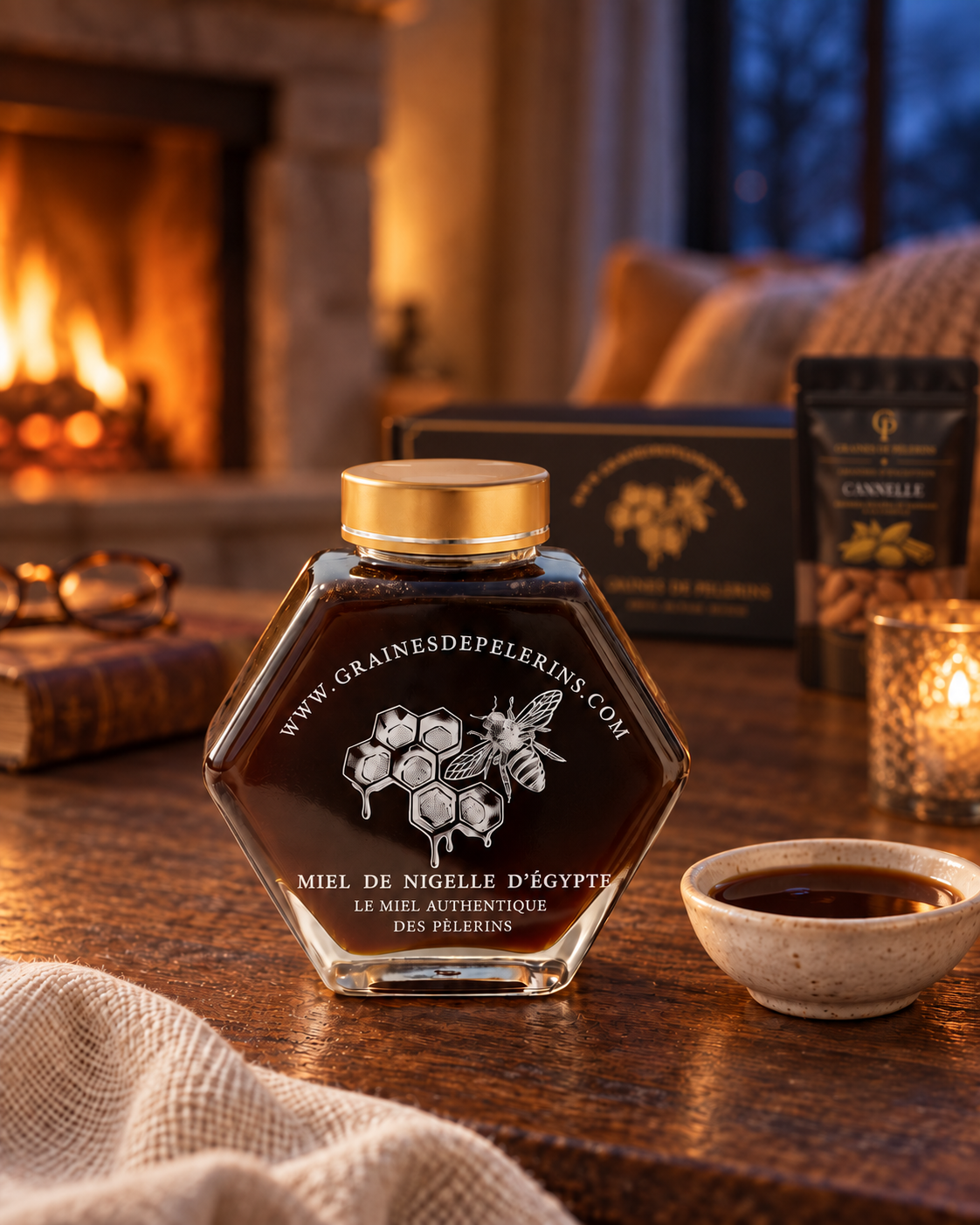
Our honey is described as mahogany in colour. Look at it in the light to enjoy its shade, without turning it into a test of authenticity. Colour alone proves neither the floral origin nor the absence of an added ingredient.
Test the texture on the spoon
The spoon lets you observe density and flow. These impressions vary, notably with temperature and composition. A runny honey is not automatically diluted; a thick honey does not, on its own, prove that it is genuine.
Taste the aroma profile
Taste a little to discover the profile: our Black Seed Honey is described as dense, with a peppery point. The intensity you perceive can vary. A less spicy taste is not enough to conclude that a product is fake.
Ask for the pollen analysis
Pollen analysis can shed light on a botanical origin; on its own it is not a definitive authentication. Methods and results have to be read within their scope. The JRC stresses the importance of suitable analyses and of traceability. Our method separates the documents available from the guarantees they do not give.
Its peppery point is discovered by tasting; its origin is documented separately.
The Graines de Pèlerins doctrineHabba sawda: seed, oil or black seed honey
Three distinct products carry very similar names. Habba Sawda (“the black seed” in Arabic) is the seed itself, from Nigella sativa. Black seed oil is pressed from those seeds. Black seed honey is made by the bees from the flowers of the plant: nectar transformed, not an extraction. Three different uses, one name for the plant they come from.
Products and claims to tell apart
A preparation with black seed oil or seeds: its composition differs from a honey of declared floral origin. It has to be identified as such; that difference alone is not grounds for accusing a product of fraud.
Colour: it can raise a question, but no visual check alone proves that a colouring has been added.
An insufficiently documented origin: ask for further information. The absence of a document you can consult does not, on its own, establish fraud.
A single-flower claim: it has to be assessed with evidence suited to the origin claimed, with no invented universal pollen threshold.
Added syrups: detecting them requires a suitable investigation. Tasting or texture is not enough to establish it.

Declared origin · Egypt
Egyptian Black Seed Honey 26,90 €
Discover the honeyGoing further
- The morning ritual of black seed honey
- How to tell if honey is real
- Our three rare honeys compared
- The seven rarest honeys
Sources & References
The honey in this article
Egyptian Black Seed Honey
A mahogany colour, a dense texture, a peppery point. See the product page to tell apart the tasting profile, the composition and the declared origin.
Discover Egyptian Black Seed Honey →In the same spirit: Habba Sawda & Black Seed Honey · How to tell if a honey is real
Editorial information. The content of this article is strictly informative, cultural and sensory. It describes the geographical origin, the botanical composition, the aroma profile and the traditional uses of rare honeys. It is not medical advice, a diagnosis, or a recommendation for treatment. Honey is a foodstuff. For any medical question, consult a qualified professional. Compliant with Regulation (EC) No 1924/2006.
Continue exploring
Pairings
The 13 desserts of Christmas in Provence: who counted to thirteen?
Mistral counted only eleven. Where does thirteen come from, what really sits on the table at Christmas in Provence, and how to set your o...
Read the article
Guide
Pain d’épices: the story of French honey spice bread, and a real recipe
For centuries, pain d’épices was a loaf of honey and rye whose dough waited for weeks. From Reims to Nuremberg, its history, the part hon...
Read the article
Classements
The best honey in the world: what the rankings say, what really counts
In 2025, the world beekeeping congress gave up awarding a honey. What contests and rankings are really worth, and the five criteria that ...
Read the articleDiscover our rare honeys
Four exceptional origins, limited harvests, gift boxes made for giving and for tasting.
See the collectionAlso worth discovering: our Almonds of Distinction