
How to recognise genuine honey (and spot a fake)
Label, origin, lab analysis: the pointers that matter when recognising a genuine honey. And what colour and texture do not prove.
Label, texture and taste give you pointers when choosing a honey. They are not enough to prove that it is genuine: no spoon trick, water test or look at the colour can replace a suitable analysis and traceability. Here is what to check, and the conclusions you should avoid drawing from it.
Contents
Recognising a genuine raw honey

The label: a precise origin and a batch number
Note the product name, its declared origin and the batch details. A more detailed geographical indication helps you ask the right questions; on its own, it proves neither the origin nor the absence of fraud. Our Lab analyses and traceability page sets out the documents available and what they cover.
The words raw, unheated or unpasteurised
The words “raw”, “unheated” and “unpasteurised” should be read in the light of what the producer states. This article does not give them a universal threshold of 35 °C. To find out how a particular honey was handled, ask for its preparation conditions and the documents that back them up.
The texture on the spoon
Dip a spoon, lift it out and watch the honey run off: it is a way of discovering a texture. How runny a honey is depends, among other things, on temperature and on its composition. A thick ribbon does not prove that there is no syrup, and a runny honey is not a fake for that reason alone.
The natural colour
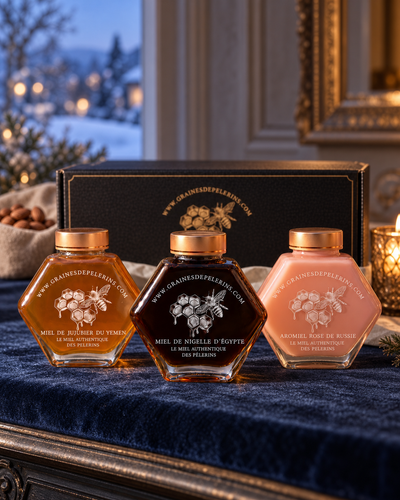
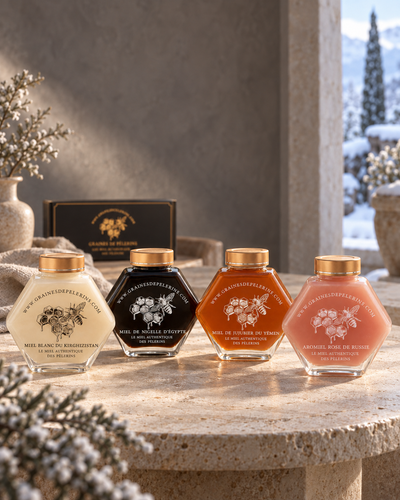
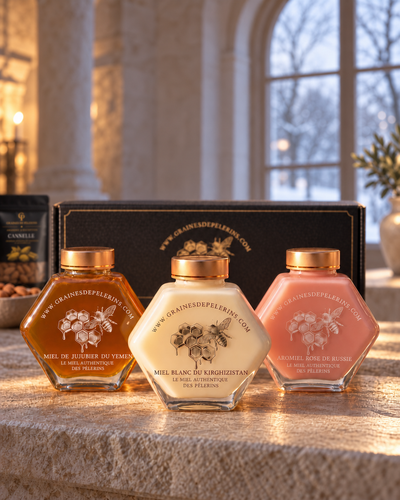
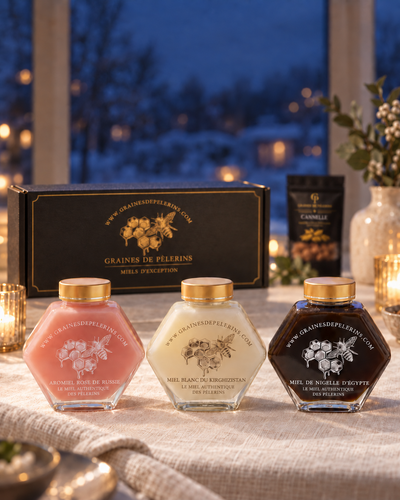
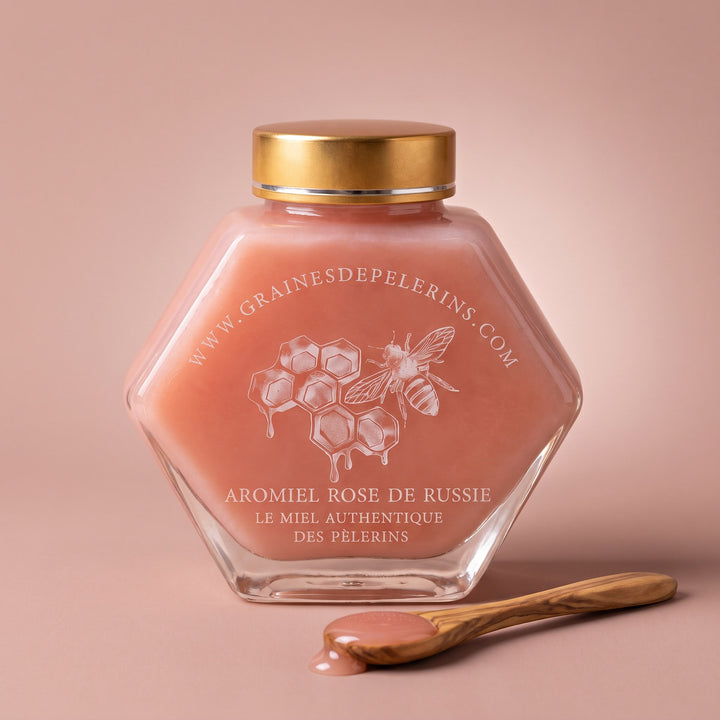
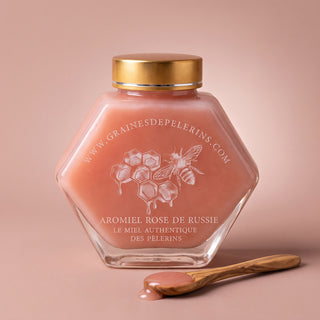
An amber, ivory or mahogany colour helps to describe a product. Colour alone cannot identify its floral origin, how it was handled or whether it is genuine. Rose Aromiel combines acacia honey with rosehip extract, the fruit of the dog rose. A creation with a creamy texture and floral, fruity notes.
Understanding blends of origins
A blend of honeys from several origins is not, in itself, fraud. You need to tell apart a blend of honeys, the stated origin and the addition of undeclared ingredients. A single-flower or geographical claim is judged on relevant evidence, without condemning a product just because the word “blend” appears on it.
Natural crystallisation over time
Crystallisation is a natural change linked to a honey's composition and to the way it is stored. Some honeys stay liquid for a long time. Neither the presence nor the absence of crystals proves, on its own, fraud or the absence of heating. Our article on crystallisation explains the difference.
Technical parameters: HMF, moisture, heat
| Parameter | What it tells you | What it does not prove on its own | What to look at |
|---|---|---|---|
| Moisture | A measure of composition | Complete authenticity | Result and measuring method |
| HMF | An analytical parameter | The whole history of the product | Result, method and context |
| Handling | The declared conditions | A universal “raw” limit | Information from the producer |
| Origin | The stated provenance | The provenance of every batch | Label and traceability |
Tasting describes the pleasure in the mouth. Traceability and analyses answer other questions.
The Graines de Pèlerins doctrineFrauds and mix-ups to tell apart
Added syrups: detecting adulteration calls for suitable methods. The European Commission's Joint Research Centre stresses that a simple test is not enough and that investigations must also look at traceability.
How the honey was handled: the effects of heating or filtering are assessed with the preparation details and the relevant analyses. They cannot be deduced from the look of the jar alone.
A preparation that is not plain honey: check its name and its ingredients. A product made with other ingredients should not be mistaken for pure honey.
Blends of honeys: bringing several origins together is not proof of adulteration. The question is whether the product and its origin are described correctly.
Origin claims: a floral or geographical name must be backed by suitable evidence. No single result is a universal guarantee for every batch.
Frequently asked questions
What is a raw honey?
Ask the producer what they mean by “raw” and which preparation conditions go with it. An undocumented temperature threshold is not enough to authenticate a honey.
Why does a honey crystallise?
Crystals can form naturally, depending on composition and storage. On its own, this change is not proof of authenticity.
What do the words “blend of EU and non-EU honeys” tell you?
They describe a blend of origins. A blend of honeys is not, on its own, fraud or proof that traceability is missing.
What is the moisture content of a raw honey?
Moisture is measured with suitable equipment or in a laboratory. A threshold presented as a “Graines de Pèlerins standard” should not be taken for granted without a document that applies to the product.

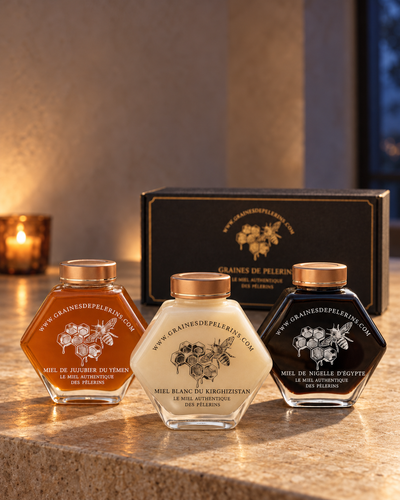
Gift box · three honeys
The Ritual Box From 23,30 € / jar
Discover the gift boxGoing further
- How to recognise a genuine black seed honey
- Why honey crystallises
- Jujubier Honey from Yemen vs Manuka
- Why rare honey costs €30 to €1,000 per kg
Sources & References
Worth discovering
Our honeys
Compare profiles and compositions, then look at the relevant documents on the page of the product that interests you.
See our rare honeys →In the same spirit: Our approach to analyses · Recognising a genuine Black Seed Honey
Editorial information. The content of this article is strictly informative, cultural and sensory. It describes the geographical origin, the botanical composition, the aroma profile and the traditional uses of rare honeys. It is not medical advice, a diagnosis, or a recommendation for treatment. Honey is a foodstuff. For any medical question, consult a qualified professional. Compliant with Regulation (EC) No 1924/2006.
Continue exploring
Pairings
The 13 desserts of Christmas in Provence: who counted to thirteen?
Mistral counted only eleven. Where does thirteen come from, what really sits on the table at Christmas in Provence, and how to set your o...
Read the article
Guide
Pain d’épices: the story of French honey spice bread, and a real recipe
For centuries, pain d’épices was a loaf of honey and rye whose dough waited for weeks. From Reims to Nuremberg, its history, the part hon...
Read the article
Classements
The best honey in the world: what the rankings say, what really counts
In 2025, the world beekeeping congress gave up awarding a honey. What contests and rankings are really worth, and the five criteria that ...
Read the articleDiscover our rare honeys
Four exceptional origins, limited harvests, gift boxes made for giving and for tasting.
See the collectionAlso worth discovering: our Almonds of Distinction